

High Paying Jobs in Pharmaceuticals

High Paying Jobs in Pharmaceuticals

 Pharmaceuticals are the important sector of the Indian economy that contributes to global healthcare. Being the principal producer and supplier of premium, high-quality drugs and medicines, India offers a diverse range of healthcare-related work opportunities with competitive pay. Since healthcare environment is continuously developing, the demand for pharmacists increases dramatically. Pharma industries in nations like India provide stability, opportunities for both professional and personal development, and high incomes across a range of healthcare domains, including research, community pharmacy, academia, and many more.

This blog will give you useful information to help you to start your career in the Indian pharmaceutical sector if you’re a student and wants to thrive and make rewarding career in pharma industries.

You will learn about the ever-changing landscape and constant need for pharmacists in India from this blog. Pharma careers with the highest salary in India: After completing their pharmaceutical studies, students have access to countless career options.

Highest paying Pharmaceuticals jobs in India:

There are endless job opportunities for students who have completed their studies in pharmacy. Some of the Highest Paid Pharma jobs are mentioned below:

1.Clinical researcher or clinical pharmacist

A clinical researcher is an expert who conducts scientific studies, plans out, and implements research to collect data. As a clinical researcher you will ensure the safety of patients during drug trials and analyse the results under the strict ethical guidelines and laws. They make sure that the patients get the appropriate number of dosages at the right time. They often conduct research that involves human trials of new drugs to know the effectiveness of new drugs and therapies. Clinical Researcher or Clinical Pharmacist is one of the best paid Pharmaceutical  jobs in India.

2.Drug Inspector

Drug Inspectors are the professionals who work with healthcare professionals and pharmaceutical companies to maintain the standards of the industry.

They conduct inspections in pharmaceutical companies and distribution centers and ensure the safety and quality of pharmaceutical products. 

In addition they look into complaints, keep an eye on medicine recalls, and enforce laws. Their main responsibility is to inspect the manufacturing process and overall quality control measures. They are essential to maintaining a pharmaceutical company’s standards and quality. They disregard the safety, labelling, and manufacturing processes of pharmaceuticals. By maintaining the integrity of the pharmaceutical supply chain, they significantly contribute to the protection of public health.

3. Biomedical Researcher

These experts play a crucial role in the advancement of medical knowledge and developing novel treatments and therapies.They focus on studying the various aspects of human health at cellular, molecular levels to develop new diagnostic tools. They conduct experiments,analyze data and interpret results to make significant contributions in the field of healthcare. These highly qualified researchers often carry out scientific research to examine the underlying mechanisms of diseases.They often work in government agencies, pharmaceutical companies, research centers and even in universities.

Biomedical researchers play a major role in contributing to the research  community by disseminating their research and publishing their journals, thus comes under the highest paid Pharma jobs in India.

4. Quality Control Analyst

Experts in quality control are in charge of carrying out several tests and inspections to assess products’ safety, compliance with regulations, and overall quality. In addition to different tests and measurements they maintain the records, samples and collaborate with different departments to handle the quality related concerns.They make sure that the product comes under the required criteria before it gets launched In the market. Quality control analysts have scope in different sectors such as pharmaceutical manufacturing, food & beverage manufacturing and many more. Quality control Analyst is one of the best paid Pharma  jobs in India.

5.Consultant Pharmacist

Consultant pharmacists are experts who guide patients and healthcare professionals on medication therapy, clinical pharmacy, pharmaceutical analysis,and make sure that patients are prescribed with appropriate medications. 

They often work with other healthcare professionals and 

businesses to promote overall health, safe and effective drug therapy to lower the risk of medication related problems.

Sometimes, consultant pharmacists review a patient’s medication regimen to identify any side effects or inefficacies. In addition, they educate patients about safe medication and suggest less expensive options without sacrificing quality.

6. Retail Pharmacist

These professionals work in a community pharmacy and interact directly with patients. They check prescriptions given by doctors, ensure that patients receive the right medications and guide them on dosage advised by the physician. 

The main role of retail pharmacists is to provide medications based on doctors prescriptions and advise patients on medications. Usually, they work in drug stores, clinics, grocery store pharmacies and give services like basic check ups, immunizations, blood pressures etc.

They are the first point of contact for patients seeking help and guidance on minor health problems.

7. Medical Representative

Popularly known as pharmaceutical sales representatives, they usually work for laboratories and pharmaceutical firms for marketing their products. They market and supply pharmaceutical products to retail stores and pharmacies. To become a medical representative it is important to have a deep understanding of drug and pharma products, their uses,benefits, side effects and dosage. In addition they must stay up to date with new guidelines and industry trends that will help them to navigate the market successfully. 

Moreover they must have strong communication skills to effectively convey messages and information. By building trust and good relations with healthcare professionals they can easily promote the  products.

Sometimes they often organize healthcare camps and conferences and such events to promote their companies products by effectively conveying their motive to people.

In conclusion, the Pharma industry in India is rapidly evolving with technology and offering vast career options.There are a number job opportunities you can explore based on your interests. The pharma industries in India are more focused on research to manufacture high quality and effective medicines for the global market.

Important Links

More Posts

Pharmacy Industry Trends Students Should Know

Pharmacy Industry Trends Students Should Know

If you ask most pharmacy students what the job actually looks like after graduation, a lot of them still picture a counter, a white coat and a steady stream of prescriptions. That picture isn’t wrong exactly; it’s just incomplete. Pharmacy today pulls in regulatory work, drug safety monitoring and even wellness trends that didn’t really exist as career paths a decade ago.

The biggest pharmacy industry trends right now include the growing importance of regulatory affairs, rising demand for pharmacovigilance and drug safety roles, pharmacists taking a front-line role against antibiotic resistance and increased hiring around biologics and biosimilars at major pharma companies.

Why These Trends Actually Matter for Students

Choosing a pharmacy course isn’t just about picking between D.Pharma and B.Pharma anymore; it’s also about understanding where the field itself is heading because that shapes what your degree can actually open up for you. Staying aware of current pharmacy industry trends early on helps you pick electives, internships and even specialisations with a bit more intention, rather than figuring it all out after graduation when options are more limited.

Regulatory Affairs Is Becoming a Real Career Track

Getting a new medicine approved and keeping it compliant afterwards isn’t a background task anymore; it’s turned into its own specialised career path. Regulatory affairs professionals handle everything from securing approval through bodies like the FDA and EMA to managing labelling changes, safety updates and ongoing compliance once a drug is already on the market. It’s detail-heavy work and it increasingly requires people who understand both the science and the paperwork side of drug development equally well.

Students interested in this direction usually benefit from building strong documentation and analytical habits early, since regulatory teams are the ones translating complex trial data into submissions regulators can actually approve. If you want a deeper look at what this role involves day to day, our earlier post on navigating regulatory affairs in the pharmaceutical industry breaks down the core responsibilities and challenges in more detail.

Antibiotic Resistance Is Putting Pharmacists on the Front Line

This one isn’t a distant industry shift; it’s already playing out in clinics and hospitals. Overuse and mismanagement of antibiotics, both in healthcare settings and in agriculture, have pushed antibiotic resistance into a genuine public health concern with resistant strains making common infections harder to treat. Pharmacists are increasingly expected to be part of the solution here, not just dispensers of medicine.

That responsibility shows up in fairly specific ways — encouraging patients to complete full antibiotic courses, pushing back against unnecessary prescriptions and helping monitor consumption patterns and resistance trends at the community level. If you’re a pharmacy student, this trend is worth paying attention to because pharmacist-led antimicrobial stewardship is only becoming more central to the profession. We’ve covered this in more depth in our post on antibiotic resistance and the role of pharmacists which walks through the causes and the pharmacist’s part in managing it.

Pharmacovigilance and Drug Safety Roles Are Growing

Once a drug hits the market, someone still has to keep watching it and that’s where pharmacovigilance comes in. It’s grown into a legitimate, structured career path with its own progression, starting from case processing and moving up into roles like Medical Writer for drug safety reports, Signal Detection Analyst or eventually Pharmacovigilance Manager overseeing entire case-processing teams.

What makes this trend relevant to students is that it builds directly on what you already learn in a standard pharmacy degree — pharmacology, drug interactions and clinical terminology form the foundation and a short certification after graduation is often enough to make you a stronger candidate for entry-level roles. Our earlier post on pharmacovigilance careers goes into the specific roles and the typical path into this field if you want to explore it further.

Biologics, Biosimilars and Where the Big Recruiters Are Headed

The hiring patterns at major pharmaceutical companies tell you a lot about where the industry is putting its money. Companies like Dr. Reddy’s are known for developing quality generics and biosimilars, while others are pushing hard into biologics, insulin research and gene-based therapies. This shift matters for students because it’s changing what recruiters actually look for — formulation and analytical chemistry skills, familiarity with quality control processes and exposure to research-driven environments are becoming more valuable than they used to be.

For a closer look at which companies are actively recruiting pharmacy graduates and what they typically hire for, our post on top companies offering jobs for pharmacy students is a useful reference point.

Rising Interest in Natural Remedies and Supplements

Not every trend in pharmacy is regulatory or lab-based; some of it is happening right at the counter. There’s a noticeable and growing interest among patients in natural remedies and dietary supplements, driven by a preference for holistic health approaches, concerns about long-term pharmaceutical side effects and a genuine desire for preventive care rather than just treatment.

Pharmacists are increasingly the ones patients turn to for guidance here which means understanding the benefits, risks and evidence quality behind herbal medicines and supplements is becoming part of the job, not just an optional interest. We’ve explored this shift in more detail in our post on natural remedies and supplements which is worth a read if patient counselling is a direction you’re drawn to.

What These Pharmacy Career Trends Mean for Choosing a Course

Put together, these pharmacy career trends point toward a field that’s a lot broader than the traditional retail-counter image most people start with. Regulatory affairs, pharmacovigilance, antimicrobial stewardship and patient counselling around supplements are all legitimate directions a pharmacy degree can lead to, provided the course itself builds a strong enough foundation in pharmacology, clinical sciences and practical lab work to support whichever path a student eventually chooses.

How KIITS Prepares Students for These Trends

KIITS, established in 2002 and affiliated with the Pharmacy Council of India, Uttarakhand Technical University and H.N.B. Uttarakhand Medical Education University, runs its B.Pharma, D.Pharma and B.Pharma Lateral Entry programmes around exactly this kind of broad foundation. The curriculum covers pharmacology, pharmaceutical chemistry and clinical sciences, subjects that feed directly into regulatory affairs work, pharmacovigilance case processing and antimicrobial stewardship alike. Faculty bring real industry experience into the classroom and the emphasis on practical, lab-based learning over pure theory means students graduate genuinely work-ready rather than just exam-ready.

Conclusion: Build Your Practical Legacy with KIITS

Pharmacy as a field is shifting well beyond the counter with regulatory affairs, drug safety monitoring, antimicrobial stewardship and patient guidance on natural remedies — all becoming legitimate, in-demand career directions alongside traditional dispensing roles and students who understand this early tend to make sharper choices about electives and internships.

This is where KIITS, as a well-established and possibly the best Pharmacy College in Dehradun, genuinely fits into the picture. By grounding its B.Pharma and D.Pharma programmes in strong pharmacology and clinical-science fundamentals, backed by faculty with real industry exposure and a hands-on, lab-focused teaching approach, KIITS gives students the kind of base that adapts to wherever the pharmacy industry moves next, whether that’s regulatory work, drug safety or patient-facing roles built around the wellness trends reshaping the profession today.

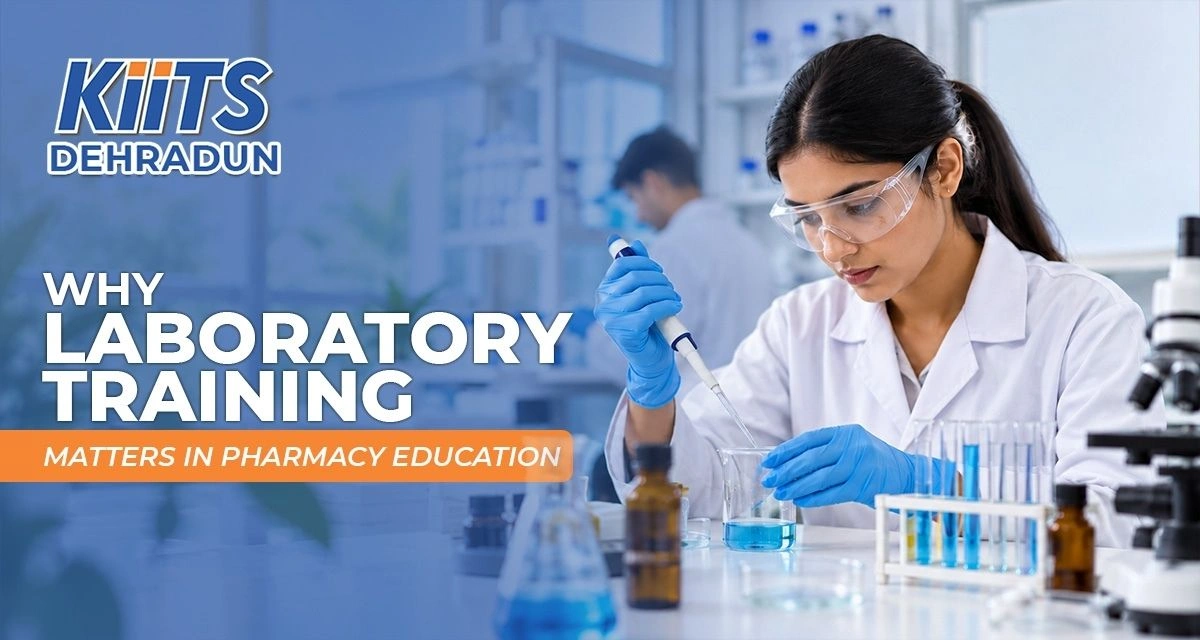
Why Laboratory Training Matters in Pharmacy Education

Why Laboratory Training Matters in Pharmacy Education

Pharmacy is often invoked as a profession of tranquil halls of pharmaceuticals and shelves of medications. The truth has a different energy. Prior to a student talking to a patient, examining a compound, or cross-checking an industrial formula, they must master how drugs act-how they dissolve, interact, break down, and engage with living matter.

That’s not something that can be learned from a book. It’s learned drop by drop in a laboratory.

Laboratory training in pharmacy education is not an add-on to a theoretical curriculum. It is the crux of what pharmaceutical competence is built upon. So, if you are seeking a Bachelor of Pharmacy in Dehradun or anywhere else, for that matter, knowing why lab work is important will help you pick the right program and make the most of your education.

Below is a detailed exposition on why practical experimentation is the very backbone of an effective pharma career.

1. Bridging the Gap Between Theory and Practice

A classroom lecture can lay out the mathematical underpinnings of a titration, the way a drug gets absorbed, or the chemistry of an emulsion. But theory can only describe.

In a lecture, a chemical equation is just letters and arrows carefully calibrated on a whiteboard. In an advanced laboratory, that same equation is an unfolding reality. By doing and experiencing practical experiments in a supported way, students are encouraged to discover the depth that exists between what a formula states and what occurs when reagents collide with glassware.

Seeing a solution change color, form a precipitate, or synthesize into a stable dosage form turns rote memorization into real physical understanding. Students come to realize that the reaction they predict in a textbook might act differently because of small factors such as changes in temperature, agitation, and exact pH. These kinds of lessons develop professional intuition, the ability to know when an analytical mixture is off before the final result indicates as much.

2. Developing Precision, Discipline, and Safety

Accuracy in pharmacy is a professional requirement, not a choice. Missing by just one microgram of API (active pharmaceutical ingredient) can make a drug potentially deadly rather than life-saving. Being a milligram off in a simple classroom experiment can be easily overlooked, but that’s not acceptable in commercial production.

Pharmacy laboratory training sets the precedent for rigorous methodological discipline for the academic journey by:

  • Precise Quantification: Acquiring skill in the specific ergonomics of digital analytical balance and micropipette use. 
  • Accurate Record-Keeping: Developing tight record-keeping habits in the blog-ready format of lab notebooks, useful in quality control as well as regulatory oversight audits. 
  • Environmental Safety Protocols: Knowing the procedures for a clean-room environment, disposal of lab chemicals, protocols to decontaminate your workspace, and the proper PPE to wear.

Beyond mere safety, the labs would create a sense of profound ethical obligation. Seeing the meticulous effort that is involved in deriving a single correct answer would immunize students with an instinctive and healthy concern for public health and an awareness of the risks of taking shortcuts in their professional careers.

3. Building Analytical and Instrumentation Skills

Pharmaceutical practice today is a highly technical profession that uses advanced equipment to practice science. Practical training teaches students to use these modern-day commercial instruments before they reach the professional world.

Students get hands-on experience with the operation and data from advanced equipment, such as:

High-Performance Liquid Chromatography (HPLC) units for compound separation.

Dissolution testing apparatus to predict how drugs release inside the body.

Advanced spectrophotometers for analyzing chemical structures.

When experiments do not go as planned – and many do not – students acquire the resilience to troubleshoot. They learn how to methodically step backwards, audit their measurements, and tweak their instruments, often under extreme stress. As the healthcare industry moves towards even tighter analytical requirements, the graduates who master these very tools will have an instant advantage in the international employability market.

4. Fostering Teamwork and Resilience

Most professionals in the pharmaceutical world do not work alone. Whether on a production line or as part of an international research group, individuals must collaborate with others to achieve success.

Laboratory environments reflect this in that students must work with their classmates to partition procedures, communicate immediate observations, and troubleshoot problems.

5. Cultivating a Research and Formulation Mindset

Pharmacy education should prepare students not just to use pre-existing information, but to generate and innovate knowledge of medicine. Lab training in the field of medicine should give students the basics of research methodology and product development.

Within the lab, students don’t simply examine compounds; they are taught to formulate new drug delivery methods, take a look at excipient mixtures, and consider shelf-life stability. This direct engagement sparks scientific curiosity and a tradition of considered research. Whether or not this scholar finally ends up working in some form of analysis and improvement, he/she learns how to contemplate like an innovator.

Key Advantages of Practical Lab Exposure

While classrooms provide the core vocabulary of pharmacy, laboratories deliver the practical capabilities required to practice it. High-quality practical exposure shapes your career through several crucial transformations:

  • Active Scientific Engagement: Transitioning from a passive consumer of scientific literature into an active practitioner of science. 
  • Industrial Protocol Mastery: Learning the precise physical movement patterns and systematic handling procedures that allow one to “click and go” on a manufacturing line. 
  • Sophisticated Equipment Handling: Abandoning generic, conceptual descriptions of high-tech instrumentation and replacing them with working knowledge of state-of-the-art technical equipment.
  • Data Literacy: Gaining the ability to decipher complex chemical readouts, identify irregularities, and publish defensible analytical data sets.
  • Repeated Trial-and-Error: Building professional grit by turning failed experiments into data-oriented puzzles that must be systematically pieced apart. 
  • Patient Advocacy: Rolling up theoretical safety and cleanliness tips into an instinctual, moral obligation to keep patients safe.

Conclusion: Build Your Practical Legacy with KIITS

In the end, it is the practical work in the laboratory that gives credibility to pharmacy education. It is the training that gives students the accuracy, the skill, the safety consciousness, and the ingenuity that the profession requires. But how much hands-on experience you get depends on the infrastructure, history, and laboratory facilities of the university of your choice.

Thus, for students who are looking for such a well-rounded programme that takes this practical grounding also seriously, KIITS (Kingston Imperial Institute of Technology and Sciences) is the only rightful selection for you.

Set in the heart of Dehradun’s picturesque surroundings, KIITS has provided over a decade of academic brilliance since 2002. Recognized by the Pharmacy Council of India (PCI) and AICTE, the institute offers a leading Bachelor of Pharmacy in Dehradun, bridging the gap between intense theory and broad practical laboratory training in pharmacy education.

The reason for KIITS’s strong institution-industrial linkages is that the university combines expert staff mentoring with thorough industrial visits, students’ improvement workshops, and fully equipped, state-of-the-art laboratories. This rigorous, hands-on approach makes its students absolutely ready to take on the corporate environment. That’s why the university boasts an elite network of esteemed recruiters, like Cipla, Sun Pharma, Mankind, Abbott, GSK, and Dr. Reddy’s.

Do not hold back your professional excellence on pure text pages. Visit the official KIITS website and get the detailed structure of our courses, know the current admission procedure, and lock your seat in our advanced labs!

Also read: Which Pharmacy Course Offers Better Career Opportunities?

Scroll to Top