



Why Laboratory Training Matters in Pharmacy Education
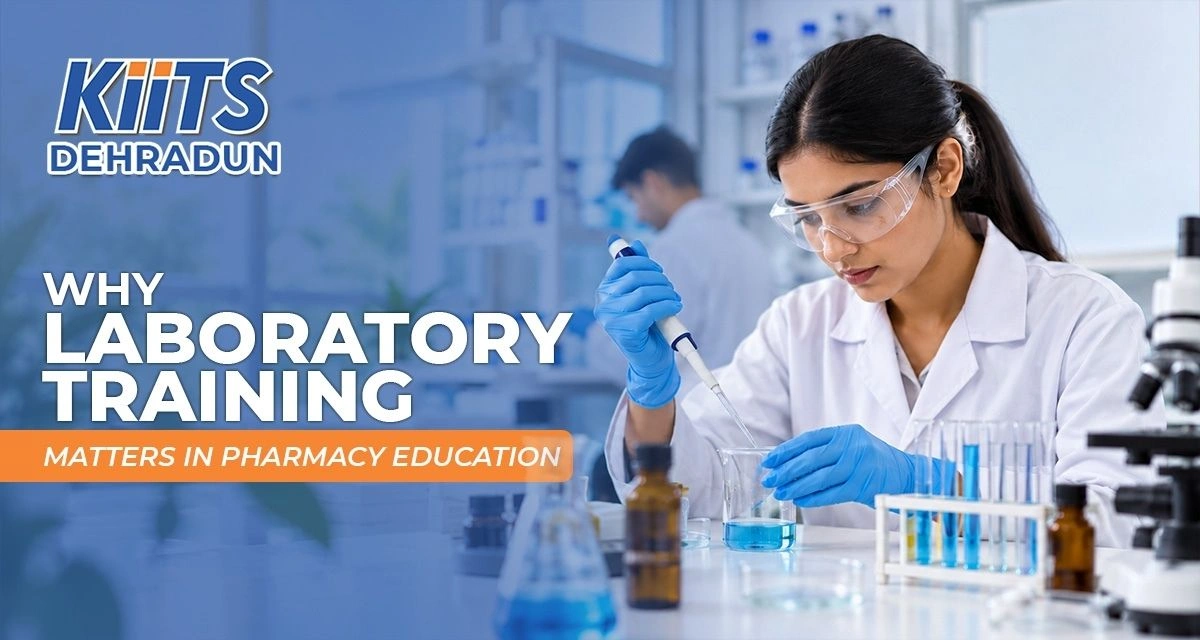
Pharmacy is often invoked as a profession of tranquil halls of pharmaceuticals and shelves of medications. The truth has a different energy. Prior to a student talking to a patient, examining a compound, or cross-checking an industrial formula, they must master how drugs act-how they dissolve, interact, break down, and engage with living matter.
That’s not something that can be learned from a book. It’s learned drop by drop in a laboratory.
Laboratory training in pharmacy education is not an add-on to a theoretical curriculum. It is the crux of what pharmaceutical competence is built upon. So, if you are seeking a Bachelor of Pharmacy in Dehradun or anywhere else, for that matter, knowing why lab work is important will help you pick the right program and make the most of your education.
Below is a detailed exposition on why practical experimentation is the very backbone of an effective pharma career.
1. Bridging the Gap Between Theory and Practice
A classroom lecture can lay out the mathematical underpinnings of a titration, the way a drug gets absorbed, or the chemistry of an emulsion. But theory can only describe.
In a lecture, a chemical equation is just letters and arrows carefully calibrated on a whiteboard. In an advanced laboratory, that same equation is an unfolding reality. By doing and experiencing practical experiments in a supported way, students are encouraged to discover the depth that exists between what a formula states and what occurs when reagents collide with glassware.
Seeing a solution change color, form a precipitate, or synthesize into a stable dosage form turns rote memorization into real physical understanding. Students come to realize that the reaction they predict in a textbook might act differently because of small factors such as changes in temperature, agitation, and exact pH. These kinds of lessons develop professional intuition, the ability to know when an analytical mixture is off before the final result indicates as much.
2. Developing Precision, Discipline, and Safety
Accuracy in pharmacy is a professional requirement, not a choice. Missing by just one microgram of API (active pharmaceutical ingredient) can make a drug potentially deadly rather than life-saving. Being a milligram off in a simple classroom experiment can be easily overlooked, but that’s not acceptable in commercial production.
Pharmacy laboratory training sets the precedent for rigorous methodological discipline for the academic journey by:
- Precise Quantification: Acquiring skill in the specific ergonomics of digital analytical balance and micropipette use.
- Accurate Record-Keeping: Developing tight record-keeping habits in the blog-ready format of lab notebooks, useful in quality control as well as regulatory oversight audits.
- Environmental Safety Protocols: Knowing the procedures for a clean-room environment, disposal of lab chemicals, protocols to decontaminate your workspace, and the proper PPE to wear.
Beyond mere safety, the labs would create a sense of profound ethical obligation. Seeing the meticulous effort that is involved in deriving a single correct answer would immunize students with an instinctive and healthy concern for public health and an awareness of the risks of taking shortcuts in their professional careers.
3. Building Analytical and Instrumentation Skills
Pharmaceutical practice today is a highly technical profession that uses advanced equipment to practice science. Practical training teaches students to use these modern-day commercial instruments before they reach the professional world.
Students get hands-on experience with the operation and data from advanced equipment, such as:
High-Performance Liquid Chromatography (HPLC) units for compound separation.
Dissolution testing apparatus to predict how drugs release inside the body.
Advanced spectrophotometers for analyzing chemical structures.
When experiments do not go as planned – and many do not – students acquire the resilience to troubleshoot. They learn how to methodically step backwards, audit their measurements, and tweak their instruments, often under extreme stress. As the healthcare industry moves towards even tighter analytical requirements, the graduates who master these very tools will have an instant advantage in the international employability market.
4. Fostering Teamwork and Resilience
Most professionals in the pharmaceutical world do not work alone. Whether on a production line or as part of an international research group, individuals must collaborate with others to achieve success.
Laboratory environments reflect this in that students must work with their classmates to partition procedures, communicate immediate observations, and troubleshoot problems.
5. Cultivating a Research and Formulation Mindset
Pharmacy education should prepare students not just to use pre-existing information, but to generate and innovate knowledge of medicine. Lab training in the field of medicine should give students the basics of research methodology and product development.
Within the lab, students don’t simply examine compounds; they are taught to formulate new drug delivery methods, take a look at excipient mixtures, and consider shelf-life stability. This direct engagement sparks scientific curiosity and a tradition of considered research. Whether or not this scholar finally ends up working in some form of analysis and improvement, he/she learns how to contemplate like an innovator.
Key Advantages of Practical Lab Exposure
While classrooms provide the core vocabulary of pharmacy, laboratories deliver the practical capabilities required to practice it. High-quality practical exposure shapes your career through several crucial transformations:
- Active Scientific Engagement: Transitioning from a passive consumer of scientific literature into an active practitioner of science.
- Industrial Protocol Mastery: Learning the precise physical movement patterns and systematic handling procedures that allow one to “click and go” on a manufacturing line.
- Sophisticated Equipment Handling: Abandoning generic, conceptual descriptions of high-tech instrumentation and replacing them with working knowledge of state-of-the-art technical equipment.
- Data Literacy: Gaining the ability to decipher complex chemical readouts, identify irregularities, and publish defensible analytical data sets.
- Repeated Trial-and-Error: Building professional grit by turning failed experiments into data-oriented puzzles that must be systematically pieced apart.
- Patient Advocacy: Rolling up theoretical safety and cleanliness tips into an instinctual, moral obligation to keep patients safe.
Conclusion: Build Your Practical Legacy with KIITS
In the end, it is the practical work in the laboratory that gives credibility to pharmacy education. It is the training that gives students the accuracy, the skill, the safety consciousness, and the ingenuity that the profession requires. But how much hands-on experience you get depends on the infrastructure, history, and laboratory facilities of the university of your choice.
Thus, for students who are looking for such a well-rounded programme that takes this practical grounding also seriously, KIITS (Kingston Imperial Institute of Technology and Sciences) is the only rightful selection for you.
Set in the heart of Dehradun’s picturesque surroundings, KIITS has provided over a decade of academic brilliance since 2002. Recognized by the Pharmacy Council of India (PCI) and AICTE, the institute offers a leading Bachelor of Pharmacy in Dehradun, bridging the gap between intense theory and broad practical laboratory training in pharmacy education.
The reason for KIITS’s strong institution-industrial linkages is that the university combines expert staff mentoring with thorough industrial visits, students’ improvement workshops, and fully equipped, state-of-the-art laboratories. This rigorous, hands-on approach makes its students absolutely ready to take on the corporate environment. That’s why the university boasts an elite network of esteemed recruiters, like Cipla, Sun Pharma, Mankind, Abbott, GSK, and Dr. Reddy’s.
Do not hold back your professional excellence on pure text pages. Visit the official KIITS website and get the detailed structure of our courses, know the current admission procedure, and lock your seat in our advanced labs!
Also read: Which Pharmacy Course Offers Better Career Opportunities?