




How to Choose Right Pharmacy Colleges For Your B.Pharm or D.Pharm

Pharmacy Colleges

Selecting the best pharmacy colleges an important choice that will influence your future in the pharmaceutical sector and the course of your career. It can be difficult to choose the finest school for your D.Pharma Diploma in Pharmacy or B.Pharma Bachelor of Pharmacy) because there are so many possibilities accessible. In order to assist you in navigating the process and coming to an informed conclusion, this article attempts to offer an in-depth explanation.

Knowledge of B.Pharm and D.Pharm

It’s critical to understand the key differences between B.Pharm and D.Pharm courses before digging into the selection criteria for pharmacy colleges.

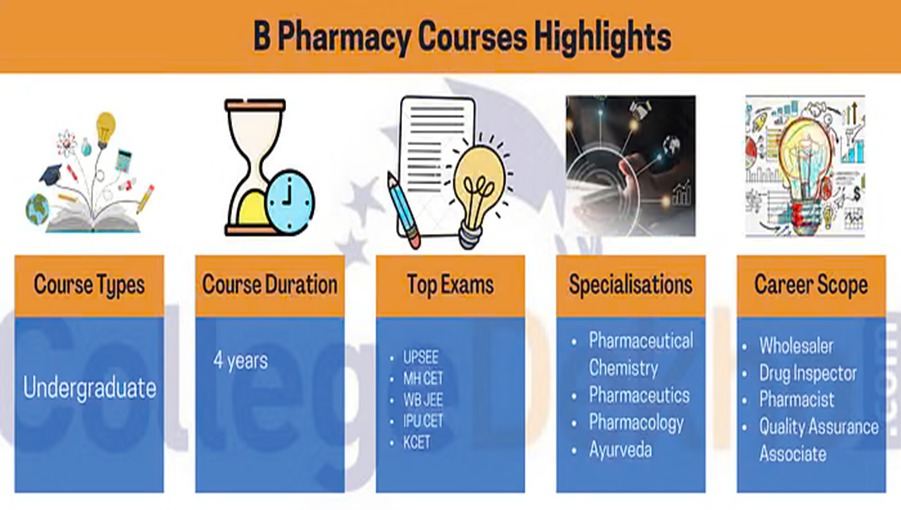
The four-year B.Pharma undergraduate programme focuses on pharmacology, the science of drug discovery, and the function of pharmacists in the medical field. Graduates of B.Pharma colleges can begin work in a variety of industries, including as pharmaceuticals, healthcare, and research, or seek further education in pharmacy or related subjects.

In contrast, the two-year D.Pharma course trains students for positions as pharmacy assistants or technicians. Graduates of D.Pharma courses receive instruction in the fundamentals of pharmacy practice, which includes patient care and prescription delivery.

Pharmacy Colleges

Important Things to Take Into Account When Selecting a Pharmacy College: 

Accreditation and Recognition

Verify that the college has been approved by the appropriate educational authorities and is accredited by the Pharmacy Council of India (PCI). Employers and other educational institutions will respect your degree if the institution is accredited, which ensures that it satisfies standards of excellence.

Coursework and Areas of Expertise

Examine the courses that the  pharmacy colleges are offering. Seek for a course that offers a good balance between lectures and practical training. Specialisations or elective courses in clinical pharmacy, industrial pharmacy, or pharmaceutical management may be offered by some colleges, which can provide them an advantage in particular career routes.

Pharmacy Colleges

Infrastructure and Faculty

The standard of the instructors and facilities can have a big influence on how well you learn. Verify the instructors’ qualifications and background. For learning and research to be conducted effectively, it is essential to have access to the newest technology, well-stocked libraries, and modern laboratories.

Partnerships with the Industry and Opportunities for Internships

Strong linkages between colleges and the pharmaceutical sector may result in excellent internship opportunities, which are crucial for obtaining real-world experience. Internships assist in developing a professional network and can result in employment offers.

Placement Data and Alumni Achievements

Examine the placement history of the college and the achievements of its former students. Successful alumni and high placement rates are signs of the school’s standing and the calibre of its curriculum.

Campus Life and Location

Your entire experience at the college may be impacted by its location. Take into account elements like the cost of living, the atmosphere in general, and the distance from pharmaceutical hubs. Your college experience can also be enhanced by a bustling campus life that offers clubs, organisations, and extracurricular activities.

A Comparison of B.Pharm and D.Pharm

Take your career objectives and the amount of time you are willing to devote to your studies into account when choosing between a B.Pharm and a D.Pharma course.
Pharmacy Colleges

B.Pharm works best if
Your goal is to advance in the pharmaceutical sector.
You intend to continue your research or postgraduate study.
You’re drawn to positions requiring in-depth knowledge of regulatory affairs and medication development.

D.Pharm works well if
You want to get some real-world experience and jumpstart your career.
You want to work as an assistant or pharmacy technician, for example.
You’re searching for a programme that is more affordable and lasts less time. development and is in line with your career goals.

You may make an educated choice that will lead to a fruitful and satisfying career in pharmacy by taking these things into account and doing your research.

What factors should you take into account when selecting B Pharma institutions for your training?
A few things to think about when selecting B Pharma colleges include infrastructure, industry ties, faculty, curriculum, accreditation, and placement history. The Pharmacy Council of India (PCI) accreditation guarantees both the college’s quality requirements and the recognition of your degree. A full education requires a curriculum that is extensive and strikes a balance between academic knowledge and hands-on training. The learning environment is further improved by knowledgeable instructors and cutting-edge labs and libraries, among other contemporary amenities. Industry relationships are crucial for supplying worthwhile internship opportunities, which are necessary for obtaining practical experience and enhancing employment prospects. Assessing placement statistics and alumni achievements can also be useful in determining the reputation of the college and the quality of its curriculum.

How can you find the top D Pharma colleges according on your desired career path?
Check out universities with good teaching, strong practical training programmes, and strong industry links to determine which D Pharma colleges are the best. In order to prepare students for immediate employment as pharmacy technicians or assistants, D Pharma courses should provide practical experience. The Pharmacy Council of India (PCI) accreditation is essential for guaranteeing that the instruction offered satisfies national requirements. Examine the college’s facilities, such as its labs and library, to make sure they facilitate all-encompassing education. Internship opportunities and industry connections are essential for improving employability and getting real-world experience.

Why is accreditation significant in the process of choosing D Pharma and B Pharma colleges?
When choosing between B Pharma and D Pharma colleges, accreditation is essential since it guarantees that the school satisfies the high requirements established by the Pharmacy Council of India (PCI). Employers and other educational institutions will recognise and value the education you obtain thanks to this recognition. Accredited pharmacy colleges guarantee that you receive a thorough and up-to-date education by offering a curriculum that is continually evaluated and revised to meet industry requirements.

What part does the curriculum have in selecting the best college of pharmacy?
A key aspect to take consideration when selecting pharmacy colleges for B.Pharm or D.Pharma degrees is the curriculum. A strong curriculum for B Pharma colleges should integrate academic understanding with real-world application in subjects like pharmaceutical chemistry, pharmaceutics, and pharmacology. The curriculum at D Pharma colleges should put an intense focus on imparting the practical knowledge and hands-on training required for positions as pharmacy assistants or technicians. A well-rounded education improves students’ preparation for the workforce and equips them for a variety of professional choices in the pharmaceutical sector.

In summary

One of the most important steps to a successful career in the pharmaceutical industry is selecting the correct pharmacy college. Make sure you thoroughly investigate and assess your selections in light of accreditation, curriculum, industry links, professors, placement history, and campus culture. Whether you decide on a D.Pharma or a B.Pharma courses, be sure the college you select supports your professional.


Important Links

More Posts

How to Build a Successful Career in the Pharmaceutical Industry

How to Build a Successful Career in the Pharmaceutical Industry

The pharmaceutical industry is one of the very few industries where science is applied to real-life applications every day. Right from the development of life-saving medicines to ensuring that these medicines are delivered safely to the patients, this industry plays a direct role in improving the health of people across the globe.

So if you have ever wondered whether a career in the pharmaceutical industry is what you are looking for, then you are not alone. Today, many students are actively looking for how to start a career in the pharma industry & what opportunities are actually available in this expanding sector.

Thus today’s blog will take you through every step, from learning more about the industry to learning about the best career options in the pharma sector.

Why Choose the Pharmaceutical Industry?

The pharmaceutical industry is growing at a fast pace globally, especially in countries such as India. With rising awareness about healthcare, advancements in medical research & a growing population, the need for skilled pharmacy professionals is increasing steadily.

Other than this, here’s why students are opting for this career

  • Strong job stability
  • Great job opportunities in India & abroad
  • Attractive salary growth
  • Research-oriented & innovation-based jobs
  • Straight contribution to healthcare & society

Additionally, the pharma industry is less likely to be affected by trends, as healthcare is always in demand. A clear example of such a situation was during COVID when businesses across all sectors were impacted, yet healthcare professionals remained on the front lines & were in exceptionally high demand.

Understanding the Pharmaceutical Industry Structure

Before delving into how to start a career in the pharma industry, it is essential to understand the structure of the industry. The pharma industry comprises

  • Research & Development (R&D) which includes drug development, clinical trials & formulation
  • Manufacturing & Production which includes the manufacturing of drugs & quality control checks
  • Regulatory Affairs in which adherence to government regulations is maintained
  • Sales & Marketing which includes marketing of drugs in an ethical manner
  • Quality Assurance in which adherence to safety standards is maintained
  • Pharmacovigilance which includes monitoring of drug safety

In the Indian pharma industry, organisations such as the Central Drugs Standard Control Organisation oversee the industry & ensure that it is safe & adheres to regulations. Worldwide, organisations such as the Food & Drug Administration in the United States set strict guidelines for the approval & monitoring of drugs.

Understanding all these segments helps you identify where your interests & strengths align.

How to Start a Career in Pharma: Step-by-Step Guide

If you are seriously thinking about this, here is a step-by-step guide to follow.

1. Choose the Right Academic Qualification

The beginning of your career is based on the right course. Some of the most sought-after courses are
  • Diploma in Pharmacy (D.Pharm)
  • Bachelor of Pharmacy (B.Pharm)
  • Master of Pharmacy (M.Pharm)
A B.Pharm degree is always the best way to start your career if you are thinking about how to start a career in pharma. It gives you a solid foundation in pharmacology, pharmaceutics, medicinal chemistry & pharmaceutical analysis.

2. Develop Practical Exposure

Pharma is not all about academics. Internships, industry visits & lab training are also important. Students who have practical exposure during their academic years feel more confident & ready to join the workforce.

So look for colleges that provide

  • Well-equipped labs
  • Industry tie-ups
  • Research opportunities
  • Hospital training exposure

3. Identify Your Career Specialisation Early

The biggest blunder that many students make is that they take a lot of time to discover their area of specialisation. The pharma industry is quite broad & if you know your area of interest early on, you can develop expertise in that area.

Some of the most sought-after career options in the pharma sector are

  • Drug Inspector
  • Pharmacist
  • Clinical Research Associate
  • Regulatory Affairs Officer
  • Quality Control Analyst
  • Medical Representative
  • Pharmaceutical Scientist
  • Production Manager

Each of these roles demands different qualities like analytical skills, communication skills, research skills & management skills.

Best Career Paths in the Pharma Sector

Let’s take a closer look at some of the best career paths.

• Research & Development (R&D)

If you are interested in lab work & research then R&D can be an extremely rewarding career path. You will be working on the development of new drugs, enhancing formulations & testing them.

This career path demands further education such as M.Pharm or PhD.

• Clinical Research

Clinical research specialists are responsible for managing clinical trials & ensuring that medicines are tested in an ethical manner. With the demand rising globally, this is one of the most rapidly growing career paths in the pharma industry.

• Regulatory Affairs

Regulatory affairs professionals are responsible for ensuring that pharmaceutical products meet national & international standards. As every pharmaceutical product has to meet strict requirements before it is introduced to the market, this is a secure career option.

• Pharmaceutical Marketing

Pharmaceutical marketing professionals & medical representatives act as a bridge between pharmaceutical companies & healthcare professionals. So if you possess excellent communication skills then a career in pharmaceutical marketing can be an excellent option.

• Government Jobs in Pharma

Government jobs such as a Drug Inspector or Government Pharmacist are secure & well-respected professions. However, candidates must clear competitive examinations to secure these government positions.

Skills Required to Succeed in Pharma

Building a successful career in pharma requires more than just a degree. It requires skills like

  • Strong knowledge of chemistry & biology
  • Attention to detail
  • Analytical thinking
  • Communication skills
  • Ethical responsibility
  • Adaptability to new technologies

Now that the industry is increasingly integrating digital tools, AI-based drug research & automation, being open to learning new technologies will give you an added advantage.

Challenges in the Pharmaceutical Industry

Each industry has its own set of challenges. In the pharma industry, professionals can encounter the following

  • Tight regulations
  • Continuous learning needs
  • High accountability for drug safety
  • Competitive scenario

But for people who are passionate about the healthcare & scientific community, these challenges are stepping stones for development.

Why KIITS College is a Strong Choice for Pharmacy Aspirants

When it comes to establishing a strong foundation in pharmacy education, KIITS College stands out as one of the most trusted institutions.

Here’s how KIITS College helps aspiring pharma professionals

  • The college offers comprehensive pharmacy courses as per industry requirements
  • The college offers well-equipped labs for hands-on experience
  • The college places great focus on research & innovation
  • The college has a team of experienced faculty members with great academic & industry knowledge
  • The college offers career counselling & placement assistance

Conclusion

Becoming successful in the pharmaceutical sector is a process that starts with the right education & exposure. From research & regulatory roles to marketing & government services, the pharmaceutical sector provides immense opportunities & the landscape is constantly changing.

So if you are planning to make your career in the pharma industry, it is important to remember that clarity, skill building & the right academic setting are essential. The pharmaceutical industry provides stability, growth & a special feeling of being part of the global healthcare community.

Institutions like KIITS College of Pharmacy provide the foundation that students need to start their journey in this ever-changing industry. With the right guidance, exposure & programs, KIITS College can be the beginning of a successful & meaningful career in the pharmaceutical industry.

What Are the Highest Paying Jobs in the Pharmacy Field?

What Are the Highest Paying Jobs in the Pharmacy Field?

If you are considering a career in pharmacy, one of the questions that you will inevitably ask is: What are the best-paying jobs?

This is a very relevant question.

And while it is true that a love for the healthcare industry is a very important factor in ensuring that you are satisfied with your chosen career, it is also true that financial security is a big factor in this regard.

The pharmacy industry today is much more diverse than many people think. It is not just about dispensing drugs over the counter. The pharmacy industry involves many other high-paying career options, including drug research and development, clinical trials and pharmaceutical marketing.

Thus in this blog, we will go through some of the highest-paying pharmacy jobs, why they are so lucrative and how you can position yourself for these careers.

Which Are the Highest Paying Pharmacy Jobs?

The highest-paying jobs in the pharmacy industry typically include roles such as
• Pharmaceutical Scientist
• Regulatory Affairs Manager
• Clinical Research Director
• Drug Inspector
• Pharmacovigilance Manager
• Pharmaceutical Marketing Manager

While these positions demand advanced education, strong technical expertise and industry experience, they also offer excellent salary growth and global opportunities.

Now, let’s break this down in detail.

Why Some Pharmacy Roles Pay More Than Others

Before delving into the list of job titles, it is important to understand why certain job titles are among the highest-paying pharmacy professions.
There are several reasons why salaries are influenced in certain ways and that include

  • Education level (B.Pharm, M.Pharm, Pharm.D, PhD)
  • Technical expertise
  • Industry experience
  • Responsibilities related to regulation
  • Leadership or management role
  • International experience

Furthermore, job titles that involve drug approval, research leadership, regulatory responsibility or strategic decision-making are likely to be higher paying because they have a direct effect on public health and company profitability.

List of Job Titles

1. Pharmaceutical Scientist

A Pharmaceutical Scientist is involved in research and development (R&D), where they are responsible for the discovery and development of new drugs. This job requires laboratory work, clinical research and formulation design.
People in this industry are likely to be working together with international regulatory agencies such as the U.S. Food and Drug Administration or in accordance with the Central Drugs Standard Control Organisation in India.

Why the Job Role Pays Well

  • Requires advanced educational degrees (M.Pharm or PhD)
  • Requires a high level of responsibility regarding drug safety and efficacy
  • Has a long-term impact on global healthcare

If research is your passion, then this is one of the top paying pharmacy careers that you can pursue.

2. Regulatory Affairs Manager

Every pharmaceutical product has to meet strict regulatory requirements before it is introduced to the market. Thus Regulatory Affairs Managers are responsible for ensuring that all requirements of national and international laws are met.

They are responsible for preparing documents, conducting audits and interacting with the regulatory bodies.

Why the Job Role Pays Well

  • The role is highly important in drug approval
  • Requires expert knowledge of regulatory requirements and international standards

Since no pharmaceutical product can be introduced to the market without regulatory approval, people in this profession are highly sought after.

3. Clinical Research Director

Clinical research is a very important aspect of modern healthcare. A Clinical Research Director is responsible for overseeing clinical research, maintaining high ethical standards and directing research staff.

Why the Job Role Pays Well

  • Involves leadership roles
  • The job role is directly related to global healthcare research
  • Requires experience and expertise

With India becoming a destination for clinical research, this is rapidly becoming one of the best-paying pharmacy jobs in the country.

4. Drug Inspector

A Drug Inspector is employed by the government to oversee drug production and enforce safety standards.

They inspect drug facilities, collect samples and pursue legal action if necessary.

Why the Job Role Pays Well

  • Government-supported job
  • High authority and accountability
  • Secure employment with good compensation

Drug Inspectors usually work in coordination with organisations such as the Central Drugs Standard Control Organisation thus making it a prestigious and secure job.

5. Pharmacovigilance Manager

Pharmacovigilance is the process of monitoring drug safety after the product is introduced to the market. A Pharmacovigilance Manager is responsible for monitoring adverse drug reactions and patient safety.

Why the Job Role Pays Well

  • There’s high accountability for drug safety monitoring
  • There’s high demand in the international market
  • Requires analytical and writing skills

With the increasing number of global pharmaceutical companies, drug safety reporting is becoming increasingly essential.

6. Pharmaceutical Marketing Manager

Pharmaceutical marketing is much more than just a sales job. Marketing Managers formulate product marketing strategies, oversee brand positioning and supervise teams of medical representatives.

Why the Job Role Pays Well

  • You play a direct role in generating revenue for the company
  • You get to be in leadership and planning roles
  • There are incentives and performance bonuses

This job is perfect for people with good communication and managerial skills.

7. Hospital Pharmacist

Retail pharmacists may have decent pay, but hospital pharmacists, especially those in multi-speciality hospitals, have the potential to earn much higher salaries.
They work hand in hand with doctors, oversee drug therapy and track patient results.

Why the Job Role Pays Well

  • The role requires specialised medical expertise
  • There’s direct patient care involvement
  • Advanced certifications can further increase earning potential

8. Production and Quality Assurance Manager

These professionals monitor manufacturing operations and ensure that they comply with Good Manufacturing Practices (GMP).

Why the Job Role Pays Well

  • You are directly responsible for product quality
  • There are supervisory and management roles
  • As you tend to gain more experience, your salary increases

How KIITS College Helps You Aim Higher for High-Paying Jobs

When considering a career in pharmacy, the college you choose can help make your future. Speaking of KIITS College, it is recognised for providing industry-specific pharmacy courses that help students prepare for a challenging and high-paying career.

Here’s how KIITS helps aspiring professionals

  • Offers comprehensive B.Pharm and advanced courses
  • Has well-equipped labs on its campus for hands-on training
  • Offers industry exposure and internships
  • Provides guidance from experienced faculty members
  • Offers career counselling and placement assistance

So students who want to make a career in research, regulatory affairs, clinical trials or pharmaceutical management, KIITS not only trains students in academics but also in skill development and industry preparation which is required for high-paying careers.

Sum up!

The pharmacy sector has much more to offer than just the traditional dispensing roles. Right from research scientists and regulatory managers to clinical directors and pharmaceutical marketing leaders, the options are endless and very rewarding.

While it’s true that the highest paying pharmacy jobs require skill, hard work and a commitment to lifelong learning, they also offer excellent career security and international opportunities. If you are targeting the most lucrative pharmacy careers then you should start by creating a strong educational foundation, hands-on experience and identifying a specialisation that matches your passions.

Institutions like KIITS offer the ideal academic setting, hands-on experience and guidance to help you prepare for these high-growth opportunities. But you have to remember that the secret to having a pharmacy career that is both rewarding and fulfilling is to start with the right foundation and set your sights high

Scroll to Top